-
-
-
Edmonton, Alberta, Canada
Mon – Sat: 8:00 AM – 7:00 PM
Please tap the button to book your appliance repair on WhatsApp.
Booking Enquiry on WhatsApp
FixNow Appliances provides fast, professional appliance repair across Edmonton, Sherwood Park, Beaumont, St. Albert, Stony Plain and nearby areas. Our licensed technicians repair fridges, washers, dryers, dishwashers, ovens, stoves and more using OEM parts and manufacturer-approved methods.
18
Nov
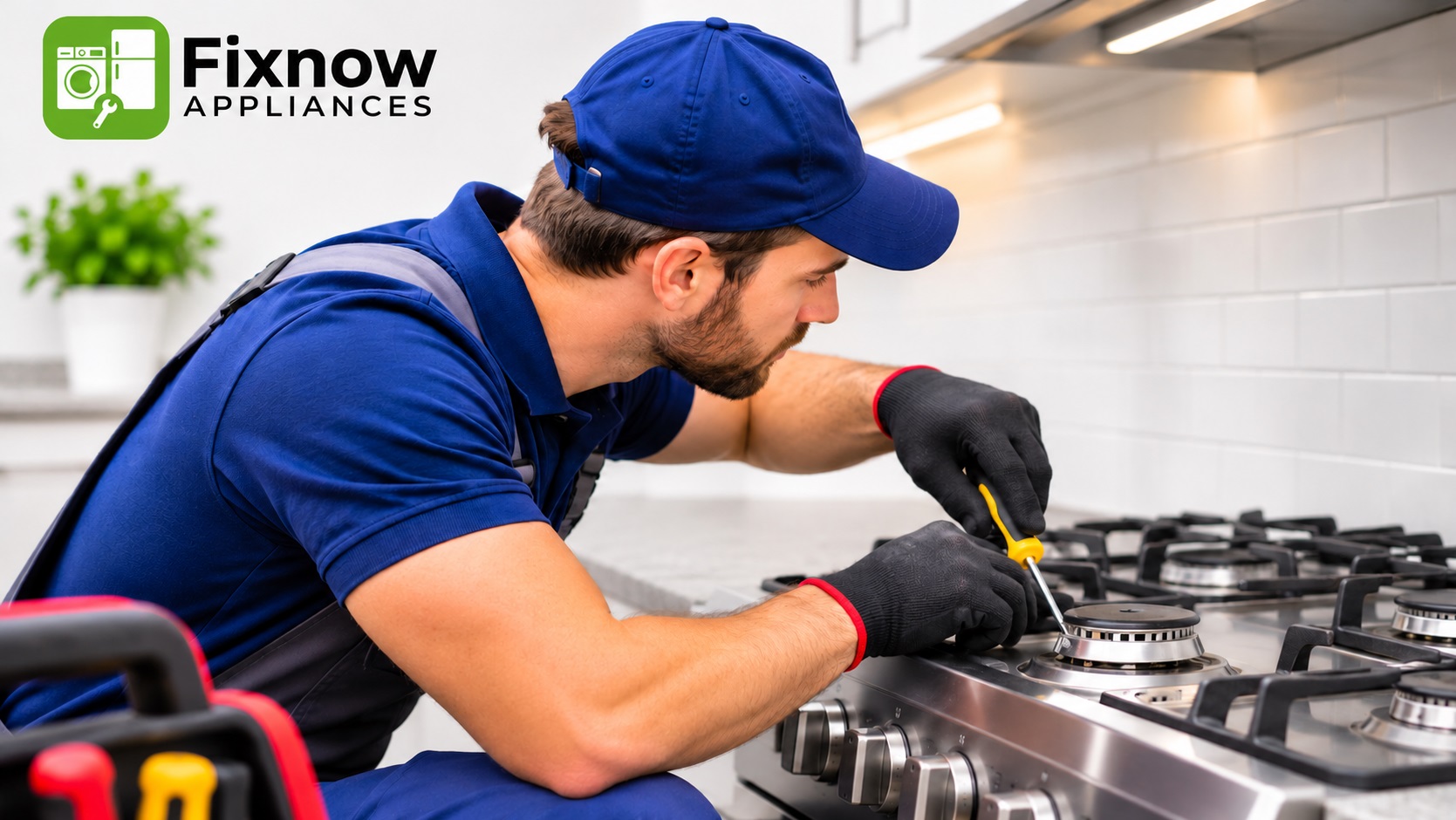
A stove is one of the most frequently used appliances in any home. Whether you are preparing a quick breakfast or cooking dinner for the family, you expect the burners to work reliably.
But what happens when a gas burner refuses to light, an electric element stops heating or the igniter keeps clicking even after the flame appears?
These problems can interrupt daily routines and, in some cases, indicate a safety concern.
For Calgary homeowners, understanding the difference between a minor burner issue and a fault that requires professional attention can help prevent further damage and unnecessary risks.
This guide from FixNow Appliances explores common gas and electric stove burner problems, their possible causes, safe checks and when to arrange professional stove repair.
A gas stove burner that clicks but does not produce a flame is a common household appliance problem.
You may hear the ignition system operating without seeing the burner light. In other cases, the burner may ignite only after several attempts.
Burner clicks but does not ignite.
Burner takes several attempts to light.
One burner fails while others work normally.
Ignition spark appears weak or inconsistent.
Burner lights and then goes out.
Blocked burner ports: Food particles, grease and cooking residue can obstruct the small openings where gas exits.
Misaligned burner cap: If the burner cap is not positioned correctly, ignition may become inconsistent.
Dirty igniter: Grease or moisture around the ignition electrode can interfere with spark generation.
Faulty ignition switch: A damaged switch may prevent the ignition system from operating correctly.
Ignition module problem: The module controls the spark system and may require professional inspection if multiple burners experience ignition issues.
Turn the burner controls off.
Allow the appliance to cool completely.
Check whether the removable burner cap is correctly positioned.
Clean accessible burner components according to the manufacturer's instructions.
Make sure the burner area is completely dry before using it again.
Do not insert sharp objects into gas openings or dismantle ignition components.
If the burner continues failing to ignite, arrange professional inspection.
A gas stove normally produces clicking sounds while its ignition system creates a spark.
However, clicking that continues after the burner has ignited or after the control has been turned off may indicate a problem.
Moisture around the igniter.
Food or grease buildup.
Burner cap not positioned correctly.
Faulty ignition switch.
Damaged spark electrode.
Ignition module malfunction.
First, turn all burner controls off.
If the appliance was recently cleaned or food boiled over, moisture may have reached the ignition area. Allow the appliance to cool and dry completely, following the manufacturer's instructions.
Check that removable burner caps are correctly positioned.
If clicking continues after the appliance is clean and dry, avoid repeated ignition attempts. A technician may need to inspect the switches, electrodes and ignition module.
If you smell gas, do not continue troubleshooting. Follow the gas-leak safety instructions below.
When three burners operate normally but one refuses to ignite, the problem may be limited to that individual burner assembly.
Blocked burner ports.
Misaligned burner cap.
Dirty ignition electrode.
Faulty spark electrode.
Damaged burner component.
Localised ignition-system problem.
Turn the burner off.
Allow it to cool completely.
Inspect the removable burner cap for visible misalignment.
Clean accessible components as directed in the appliance manual.
Ensure everything is dry before attempting normal operation.
Do not attempt to adjust gas flow or repair internal connections.
If the burner still does not ignite, professional diagnosis can help identify whether the issue involves the burner assembly or ignition system.
A gas burner should produce a consistent flame appropriate to its design and selected setting.
If the flame becomes unusually weak, uneven or unstable, the burner may not be operating correctly.
Flame appears smaller than usual.
Flame is uneven around the burner.
Burner takes longer to heat cookware.
Flame repeatedly goes out.
Cooking performance changes unexpectedly.
Blocked burner openings.
Incorrectly positioned burner cap.
Grease or food residue.
Burner component damage.
Gas supply or pressure issue.
After switching off the burner and allowing it to cool, inspect the visible burner components for food debris or incorrect positioning.
Clean only the parts approved for homeowner maintenance.
If the flame remains weak or irregular, stop using that burner and arrange professional inspection. Gas pressure and supply components should not be adjusted by homeowners.
Flame appearance can provide useful information about burner performance.
Although brief colour changes may occur under certain conditions, a persistent yellow or orange flame should not be ignored.
Dirty burner openings.
Incorrect air-to-gas mixture.
Burner damage.
Combustion or ventilation problem.
If the flame remains unusually yellow or orange, turn the burner off and arrange an inspection by a qualified gas-appliance professional.
Do not attempt to adjust the air shutter, gas valve or other combustion components yourself.
If you also experience unusual odours, soot buildup or symptoms such as headaches and dizziness, leave the area and seek appropriate emergency assistance.
Electric stoves use heating elements to transfer heat to cookware.
When an electric burner stops heating, the problem may involve the element, connection, control switch or electrical system.
Burner does not heat at all.
Burner heats intermittently.
Heating takes longer than usual.
Element does not respond to temperature settings.
One burner works while another remains cold.
Damaged heating element: The element may become worn or fail over time.
Faulty burner switch: The control switch regulates power to the heating element.
Electrical connection problem: A damaged or loose connection may interrupt normal operation.
Control board fault: Some modern cooktops use electronic controls to manage heating.
Confirm that the correct burner control is selected.
Check whether the appliance has power.
Look for visible damage without touching the heating element.
Check the household circuit breaker if it is safe to do so.
Never remove electrical panels or test live connections yourself.
If the breaker trips repeatedly or the burner shows signs of electrical damage, stop using the appliance and seek qualified assistance.
Uneven heating can make cooking unpredictable.
Food may cook too quickly in one area while remaining undercooked in another.
Worn heating element.
Damaged burner connection.
Faulty temperature control.
Incorrect cookware.
Cooktop surface or element damage.
Use cookware suitable for your stove type and make sure it sits flat on the cooking surface.
If one burner continues heating inconsistently while other burners operate normally, the element or its control system may require inspection.
For glass-top and induction cooktops, do not attempt to remove or repair the internal heating system.
Induction cooktops work differently from traditional gas and electric stoves.
They use electromagnetic energy to heat compatible cookware. If the cooktop does not recognise a pan, it may not begin heating.
Cooktop displays a pan-detection warning.
Heating stops unexpectedly.
One cooking zone does not respond.
Display shows an error code.
Cookware does not heat despite the selected setting.
Incompatible cookware.
Cookware positioned incorrectly.
Pan base too small for the cooking zone.
Overheating protection activated.
Faulty sensor or electronic control.
Confirm that the cookware is induction-compatible.
Position the pan in the centre of the cooking zone.
Check the manufacturer's recommended cookware size.
Allow the cooktop to cool if an overheating warning appears.
Review the displayed error code in the appliance manual.
If the cooktop continues showing errors with compatible cookware, professional inspection may be needed.
A gas burner that ignites and then goes out can be frustrating, particularly when the problem occurs repeatedly.
Burner cap misalignment.
Blocked burner ports.
Faulty flame-sensing component.
Ignition system problem.
Gas supply issue.
Some gas appliances use a safety device designed to stop gas flow if the flame is not detected.
If the burner repeatedly goes out, stop using it rather than holding the control down or repeatedly attempting ignition beyond the manufacturer's instructions.
A qualified technician can inspect the burner, ignition system and safety components.
The ignition system creates the spark needed to light a gas burner.
When the spark becomes weak or disappears, the burner may fail to ignite.
No visible spark.
Spark appears irregular.
Only certain burners produce a spark.
Ignition takes several attempts.
Clicking sound becomes inconsistent.
Dirty ignition electrode.
Damaged spark wire.
Faulty ignition switch.
Ignition module failure.
Moisture around electrical components.
A technician can test the ignition components and determine whether a switch, electrode, wiring or module requires repair.
Avoid opening the control panel or handling ignition wiring yourself.
A gas smell is not an ordinary burner problem. It may indicate a gas leak and requires immediate safety action.
Natural gas is given a distinctive rotten-egg-like odour to help people recognise a possible leak.
Leave the building immediately.
Take other occupants and pets with you.
Do not light matches, smoke or create flames.
Do not operate lights, electrical switches, appliances or phones inside.
Once safely outside, call ATCO's natural gas emergency line or 911.
Do not re-enter until emergency responders or the gas utility confirm it is safe.
For Calgary and surrounding ATCO-served areas, the ATCO natural gas emergency number is 1-800-511-3447.
Do not attempt to locate or repair the leak yourself. The City of Calgary and ATCO provide the same essential guidance: leave immediately, leave switches and appliances alone, and call from a safe location. <Cite refs={["turn640290search1","turn640290search0"]}/>
Some basic checks may help identify simple burner problems, but homeowners should avoid internal gas and electrical repairs.
Before performing any inspection, turn off the appliance and allow hot surfaces to cool.
Make sure removable burner caps are correctly aligned according to the manufacturer's instructions.
Remove visible food residue using approved cleaning methods. Do not damage or enlarge the burner openings.
If food or cleaning liquid has reached the burner area, allow it to dry completely before using the appliance, following the manual.
For electric and induction cooktops, use compatible cookware and follow the manufacturer's recommendations.
If the stove has a digital display, record any error code and consult the manual.
For an electric stove, check the external power supply and circuit breaker if safe.
If the breaker trips repeatedly, stop using the appliance and seek qualified electrical assistance.
A burner that continues failing to ignite, an electric element that stops heating or repeated ignition clicking may indicate a component fault.
Consider professional stove repair when:
A gas burner repeatedly fails to ignite.
Ignition continues clicking after the appliance is dry and correctly assembled.
The flame is persistently weak or uneven.
An electric burner does not heat.
A burner heats inconsistently.
The cooktop repeatedly displays error codes.
The burner ignites but does not stay lit.
The appliance trips the circuit breaker.
You notice unusual heat, smoke or electrical odours.
If you smell gas, evacuate and contact the gas utility or emergency services first. Do not treat a suspected gas leak as a routine repair booking.
A stove that develops a burner or ignition problem does not automatically need replacement.
Many common faults involve individual components that may be repaired or replaced.
However, the decision depends on the appliance's age, condition and the extent of the problem.
Consider these factors:
Type of fault: A burner component, ignition switch or heating element may be repairable. Extensive damage to the control system or appliance structure needs careful evaluation.
Appliance age: Older stoves may have more worn components, but age alone does not determine whether replacement is necessary.
Repair history: Frequent breakdowns may indicate that replacement deserves consideration.
Parts availability: Some older models may have limited access to compatible components.
Overall condition: Check for corrosion, damaged controls, cracked cooktop surfaces and other signs of wear.
Expected reliability: Consider whether the recommended repair is likely to restore dependable operation.
A professional diagnosis can help you compare repair and replacement options before making a decision.
Regular maintenance can help reduce avoidable burner and ignition problems.
Remove food spills and grease using the cleaning methods recommended by the manufacturer.
Make sure removable burner caps are correctly seated after cleaning.
Prevent cleaning liquids and food spills from collecting around ignition components.
Choose cookware appropriate for your gas, electric or induction cooktop.
Follow the manufacturer's recommended settings and cookware guidance.
Do not ignore repeated clicking, weak flames, uneven heating or unusual electrical sounds.
If a stove develops recurring ignition or heating problems, arrange a professional assessment rather than repeatedly attempting to operate it.
Regular care cannot prevent every failure, but it can help identify warning signs before they become more serious.
A stove burner that refuses to ignite or an electric element that stops heating can disrupt everyday cooking. Identifying the actual cause is the first step towards a practical repair decision.
Whether your gas stove keeps clicking, one burner is not lighting, an electric element is not heating or your cooktop displays an error code, the right diagnosis can help determine the next step.
FixNow Appliances provides appliance repair services for major household appliances.
Calgary homeowners experiencing stove or cooktop problems can visit the company website to discuss their repair requirements and confirm current service availability for their location.
Company: FixNow Appliances
Website: https://fixnowappliances.ca/
Possible causes include blocked burner ports, a misaligned burner cap, moisture around the igniter or a faulty ignition component. If the burner does not light after basic safe checks, arrange professional inspection.
Continuous clicking may be caused by moisture, grease buildup, a faulty ignition switch or a damaged spark component. Turn the controls off and arrange inspection if the clicking continues after the burner is dry.
The problem may involve that burner's cap, ports, igniter or heating component. Other burners working normally can help narrow down the issue, but the faulty burner may still need professional diagnosis.
Possible causes include blocked burner openings, a misaligned burner cap or a gas supply problem. Persistent irregular flames should be inspected by a qualified professional.
Common causes include a damaged heating element, faulty burner switch, electrical connection problem or control board fault.
Homeowners can clean removable, user-accessible components according to the manufacturer's instructions after the appliance has cooled. Do not dismantle gas connections, alter burner openings or repair ignition wiring.
Possible causes include burner obstruction, cap misalignment, ignition problems or a faulty flame-sensing safety component. Repeated failure should be professionally inspected.
Leave the building immediately. Do not operate electrical switches or appliances, and do not use a phone inside. Call ATCO at 1-800-511-3447 or 911 from a safe location outside.
Yes. Moisture around ignition components can interfere with spark generation and may cause repeated clicking. Allow the appliance to dry according to the manufacturer's instructions before normal use.
The cookware may not be induction-compatible, may be incorrectly positioned or may not meet the cooking zone's size requirements. Consult the appliance manual for suitable cookware.
It may be. Faults involving individual ignition components, switches or burner parts may be repairable. The decision depends on the appliance's condition, age and parts availability.
Visit https://fixnowappliances.ca/ to discuss your stove or cooktop problem and confirm current service availability for your location.
Leave A Reply
Your email address will not be published. Required fields are marked *