-
-
-
Edmonton, Alberta, Canada
Mon – Sat: 8:00 AM – 7:00 PM
Please tap the button to book your appliance repair on WhatsApp.
Booking Enquiry on WhatsApp
FixNow Appliances provides fast, professional appliance repair across Edmonton, Sherwood Park, Beaumont, St. Albert, Stony Plain and nearby areas. Our licensed technicians repair fridges, washers, dryers, dishwashers, ovens, stoves and more using OEM parts and manufacturer-approved methods.
27
Nov
A dishwasher is designed to make kitchen cleanup easier, but when it stops draining properly, the convenience quickly disappears. You may open the door after a completed cycle and find standing water at the bottom, dirty dishes or an unpleasant smell coming from inside the appliance.
A dishwasher that is not draining does not always have a major mechanical fault. In many cases, the problem is caused by a clogged filter, blocked drain hose, food debris or an issue with the drainage connection.
However, persistent drainage problems can also indicate a faulty drain pump, electrical issue or control-system malfunction.
Understanding the possible causes can help you identify simple problems, avoid unnecessary troubleshooting and decide when professional dishwasher repair is the right option.
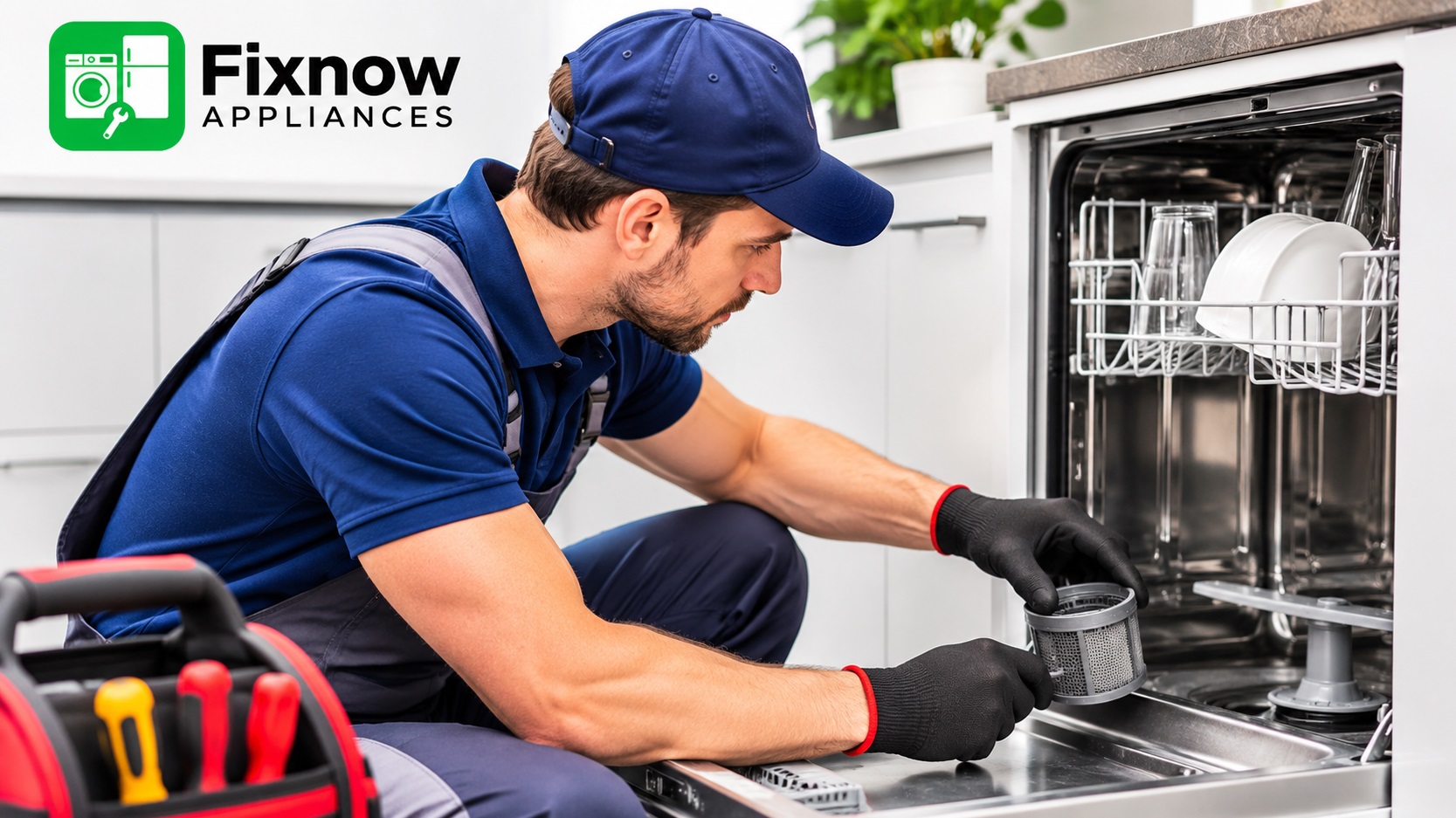
A clogged filter is one of the most common reasons a dishwasher fails to drain properly.
During washing, food particles, grease and other debris collect in the filtration system. Over time, this buildup can restrict water movement and affect drainage.
Standing water at the bottom of the dishwasher.
Food particles remaining after a wash cycle.
Unpleasant smells inside the appliance.
Dishes coming out dirty.
Slow or incomplete drainage.
Switch off the dishwasher before cleaning.
Remove the lower rack if necessary.
Locate the filter according to the manufacturer's instructions.
Remove the filter carefully.
Rinse away food particles and grease using the recommended cleaning method.
Reinstall the filter correctly.
Avoid using sharp objects or excessive force when cleaning the filter. If the dishwasher still does not drain after cleaning, another part of the drainage system may be responsible.
The drain hose carries wastewater away from the dishwasher and into the household drainage system.
If the hose becomes blocked, twisted or incorrectly positioned, water may remain inside the appliance.
Food debris inside the hose.
Grease accumulation.
A kinked or crushed hose.
Incorrect hose installation.
Blockage near the connection point.
Dishwasher stops before completing the cycle.
Water remains at the bottom.
Drainage takes longer than usual.
Gurgling sounds occur during draining.
Water returns into the dishwasher after draining.
Inspect the visible portion of the drain hose for kinks, crushing or obvious damage.
Do not disconnect hoses or attempt to clear internal blockages unless you are comfortable following the manufacturer's instructions and can safely isolate the appliance and water supply.
If the hose appears clear but drainage remains poor, professional inspection may be necessary.
The drain pump moves wastewater out of the dishwasher during the drainage stage.
If the pump becomes blocked, damaged or electrically defective, water may not leave the appliance.
Dishwasher makes a humming sound but does not drain.
No noticeable pumping sound during the drain stage.
Standing water remains after the cycle.
Drainage problems occur repeatedly.
Dishwasher displays a drainage-related error code.
Food debris obstructing the pump.
Broken or damaged pump impeller.
Worn pump motor.
Electrical connection problem.
Control-system fault.
A drain pump is an internal component. Diagnosing it may require removing access panels and testing electrical connections.
For safety, avoid opening the pump assembly or attempting electrical repairs yourself. A qualified technician can determine whether the pump is blocked, damaged or receiving the correct electrical supply.
Some dishwasher installations connect the drain hose to a garbage disposal. Others use a separate air gap to help prevent wastewater from flowing back into the appliance.
A blockage in these connections can interrupt drainage.
Water remains inside the dishwasher.
Water backs up during the drain cycle.
Gurgling sounds occur near the sink.
Wastewater appears around the air gap.
Dishwasher drainage problems begin after garbage disposal installation.
Check whether the sink drains normally.
Look for visible debris around an accessible air-gap cover, if installed.
Confirm whether the garbage disposal is operating normally.
Consider whether the drainage problem started after recent plumbing work.
If a new garbage disposal was installed, its dishwasher inlet connection may need to be checked. Some disposals have a knockout plug that must be removed during installation.
Do not dismantle plumbing connections unless you can do so safely. A plumber or appliance technician can inspect the installation and identify the obstruction.
The sump area collects water before it moves through the drainage system.
Food particles, labels, broken glass or other debris may accumulate around accessible filter and sump areas.
Dishwasher drains slowly.
Water remains around the filter.
Pump makes unusual sounds.
Food debris appears after washing.
Drainage problems return shortly after cleaning.
Remove and clean the accessible filter according to the manufacturer's instructions.
Look for visible debris around the filter opening without reaching into areas containing sharp objects or internal moving components.
If broken glass or an obstruction appears to be lodged deeper inside the appliance, stop and arrange professional inspection.
Some dishwasher designs use a check valve or other drainage-control components to help wastewater flow in the correct direction.
If a valve becomes stuck, damaged or obstructed, drainage may be affected.
Water drains slowly.
Wastewater flows back into the dishwasher.
Standing water returns after a completed cycle.
Drainage problems occur intermittently.
The exact valve arrangement depends on the dishwasher model.
A technician can inspect the drainage assembly and determine whether a valve needs cleaning, repair or replacement.
Sometimes, the dishwasher may not complete its programme because of a door-latch, control or cycle interruption issue.
If the appliance stops before reaching the drainage stage, water can remain inside even when the drain pump itself is working correctly.
Door not securely closed.
Faulty door latch.
Power interruption.
Programme interrupted manually.
Electronic control problem.
Confirm that the door closes securely.
Check whether the selected cycle completed.
Look for an error message on the display.
Consult the manual for the correct drain or cancel-cycle procedure.
If the dishwasher repeatedly stops before draining, professional diagnosis can help identify the underlying problem.
Modern dishwashers use sensors and electronic controls to monitor water levels and drainage performance.
When the appliance detects that water is not leaving within the expected time, it may display an error code.
The meaning of the code varies by brand and model.
| Error category | Possible issue |
|---|---|
| Drainage error | Water is not draining correctly |
| Water-level error | Incorrect water-level reading |
| Pump error | Drain pump or related circuit problem |
| Sensor error | Faulty or inaccurate sensor |
| Control error | Electronic control malfunction |
Record the exact error code.
Note when it appears.
Check the appliance manual.
Identify the brand and model number.
Avoid repeatedly resetting the dishwasher without investigating the problem.
An error code provides a useful diagnostic clue, but it does not always identify the failed component by itself.
A dishwasher may remove most of its wastewater but leave a noticeable amount behind.
A small amount of water in the sump area can be normal on some models. However, visible standing water covering the bottom of the tub may indicate a drainage problem.
Partially blocked filter.
Restricted drain hose.
Weak or failing drain pump.
Plumbing restriction.
Drainage installation issue.
Check the filter and visible hose condition first. If water continues to remain in the tub after a complete cycle, arrange further inspection.
If the dishwasher appears to drain successfully but water returns later, the problem may involve wastewater flowing back through the drainage connection.
Incorrect drain hose routing.
Missing or incorrectly installed high loop.
Air-gap obstruction.
Garbage disposal connection problem.
Plumbing drainage restriction.
Faulty check valve.
Dishwasher drain hose routing varies by installation and manufacturer. Follow the appliance installation manual rather than assuming every model uses the same arrangement.
A technician or plumber can inspect the drainage connection and correct installation-related problems.
Standing water can create unpleasant smells and make it difficult to use the dishwasher.
Before arranging a repair, follow these basic precautions.
If the dishwasher is still running abnormally, stop the cycle using the manufacturer's recommended procedure.
Disconnect power using the normal plug or circuit breaker only if it is safe to access and there is no water near electrical connections.
Place towels around the appliance if there is a risk of water spilling onto the floor.
Clean the filter only according to the manufacturer's instructions.
Do not pour chemical drain cleaners into the dishwasher. They can damage components and may create hazardous conditions.
If water remains after basic checks, the pump, hose, plumbing connection or internal drainage system may need attention.
It is generally better to stop using a dishwasher that repeatedly leaves standing water until the cause has been identified.
Continuing to operate an appliance with a drainage fault may lead to:
Unpleasant odours.
Poor cleaning performance.
Water leakage.
Repeated cycle interruptions.
Additional strain on the drainage system.
If water is leaking onto the floor or near electrical connections, stop using the appliance and seek appropriate assistance.
Basic filter cleaning and visible hose inspection may resolve some drainage problems. However, internal pump, wiring, valve and control-system faults require appropriate diagnosis.
Consider professional dishwasher repair if:
Water remains after every wash cycle.
The dishwasher makes unusual pumping noises.
A drainage error code keeps returning.
Water flows back into the appliance.
The drain pump does not appear to operate.
Water leaks from underneath the dishwasher.
Cleaning the filter does not improve drainage.
The appliance stops before completing its programme.
A professional inspection can help identify the actual fault instead of replacing components unnecessarily.
Preparing a few details before contacting a repair company can make the service process more efficient.
Determine whether your appliance is:
Built-in dishwasher.
Freestanding dishwasher.
Compact dishwasher.
Portable dishwasher.
Drawer-style dishwasher.
The model number helps identify the appliance specifications and compatible replacement parts.
It is commonly located around the door frame, inner door panel or manufacturer label.
Describe what happens during the wash cycle.
For example:
Water remains at the bottom.
Dishwasher drains very slowly.
Drain pump makes unusual sounds.
Water returns after draining.
Dishwasher displays an error code.
Appliance stops before completing the cycle.
Before confirming an appointment, ask:
Is my dishwasher brand and model supported?
Is a diagnostic or service-call fee applicable?
Will I receive an estimate before repairs begin?
Are compatible replacement parts available?
What warranty applies to completed repairs?
What is the expected service process?
Clear communication helps you understand the repair process before the technician visits.
A dishwasher that is not draining does not automatically need replacement.
Many drainage problems can be resolved by cleaning or repairing an individual component. However, the best decision depends on the appliance's age, condition and repair requirements.
Consider:
Age of the dishwasher.
Frequency of previous breakdowns.
Availability of compatible parts.
Condition of the wash system.
Extent of the drainage fault.
Repair estimate.
Expected reliability after repair.
A relatively new dishwasher with a blocked filter, damaged hose or isolated pump problem may be a suitable repair candidate.
An older appliance with repeated faults or extensive internal damage may require a replacement assessment.
A professional diagnosis can help compare repair and replacement options.
Regular maintenance can help reduce avoidable drainage issues and support consistent cleaning performance.
Remove food particles and grease according to the manufacturer's maintenance schedule.
Remove large food scraps before loading dishes. Most dishwashers are designed to handle normal food residue, not large quantities of solid waste.
Inspect accessible spray arms for blocked openings and clean them according to the manual.
Choose detergent designed for automatic dishwashers. Avoid using regular handwashing liquid because excessive foam can interfere with operation.
Look for obvious kinks, crushing or damage.
If your dishwasher shares a drainage connection with the sink or garbage disposal, normal sink drainage is also important.
Use the recommended cleaning cycle and maintenance products for your specific model.
Regular maintenance cannot prevent every breakdown, but it can help identify developing problems before they become more serious.
A dishwasher that is not draining can have several possible causes, from a clogged filter to a faulty drain pump or plumbing connection.
Accurate diagnosis is important because replacing the wrong component can lead to unnecessary expense and recurring problems.
FixNow Appliances provides appliance repair services for household dishwashers and other major appliances.
Whether your dishwasher is leaving standing water, making unusual pumping noises, displaying a drainage error or failing to complete a wash cycle, sharing the symptoms and model number can help the repair team understand your requirements.
Before booking, discuss your appliance's condition, service availability, diagnostic charges, repair estimate and applicable warranty terms.
Company: FixNow Appliances
Website: https://fixnowappliances.ca/
Visit the website to discuss your dishwasher drainage problem and confirm service availability for your location.
Common causes include a clogged filter, blocked drain hose, faulty drain pump, plumbing restriction or drainage-control problem.
Some dishwasher models retain a small amount of water in the sump area. However, standing water covering the bottom of the tub after a completed cycle may indicate a drainage issue.
Yes. Food particles, grease and debris can restrict water movement through the filtration system and affect drainage.
Possible signs include repeated drainage failures, unusual humming sounds, standing water and a pump that does not operate as expected. Professional testing is needed to confirm the fault.
Water may be flowing back through the drainage connection because of incorrect hose routing, a plumbing restriction, air-gap blockage or a faulty check valve.
No. Household chemical drain cleaners are not designed for dishwasher drainage systems and may damage components or create hazardous conditions.
A humming noise may indicate that the drain pump is attempting to operate but cannot move water properly. A blockage, damaged pump or electrical problem may be responsible.
The appliance may have detected that water is not draining within the expected time. Check the manual for the exact error-code meaning for your model.
Cleaning frequency depends on usage and manufacturer recommendations. Regular inspection helps prevent food debris and grease from accumulating.
Arrange professional inspection if standing water repeatedly remains, drainage errors return, the pump makes unusual noises or cleaning the accessible filter does not resolve the issue.
Visit https://fixnowappliances.ca/ to discuss your dishwasher problem and confirm service availability for your location.
Leave A Reply
Your email address will not be published. Required fields are marked *