-
-
-
Edmonton, Alberta, Canada
Mon – Sat: 8:00 AM – 7:00 PM
Please tap the button to book your appliance repair on WhatsApp.
Booking Enquiry on WhatsApp
FixNow Appliances provides fast, professional appliance repair across Edmonton, Sherwood Park, Beaumont, St. Albert, Stony Plain and nearby areas. Our licensed technicians repair fridges, washers, dryers, dishwashers, ovens, stoves and more using OEM parts and manufacturer-approved methods.
26
Nov
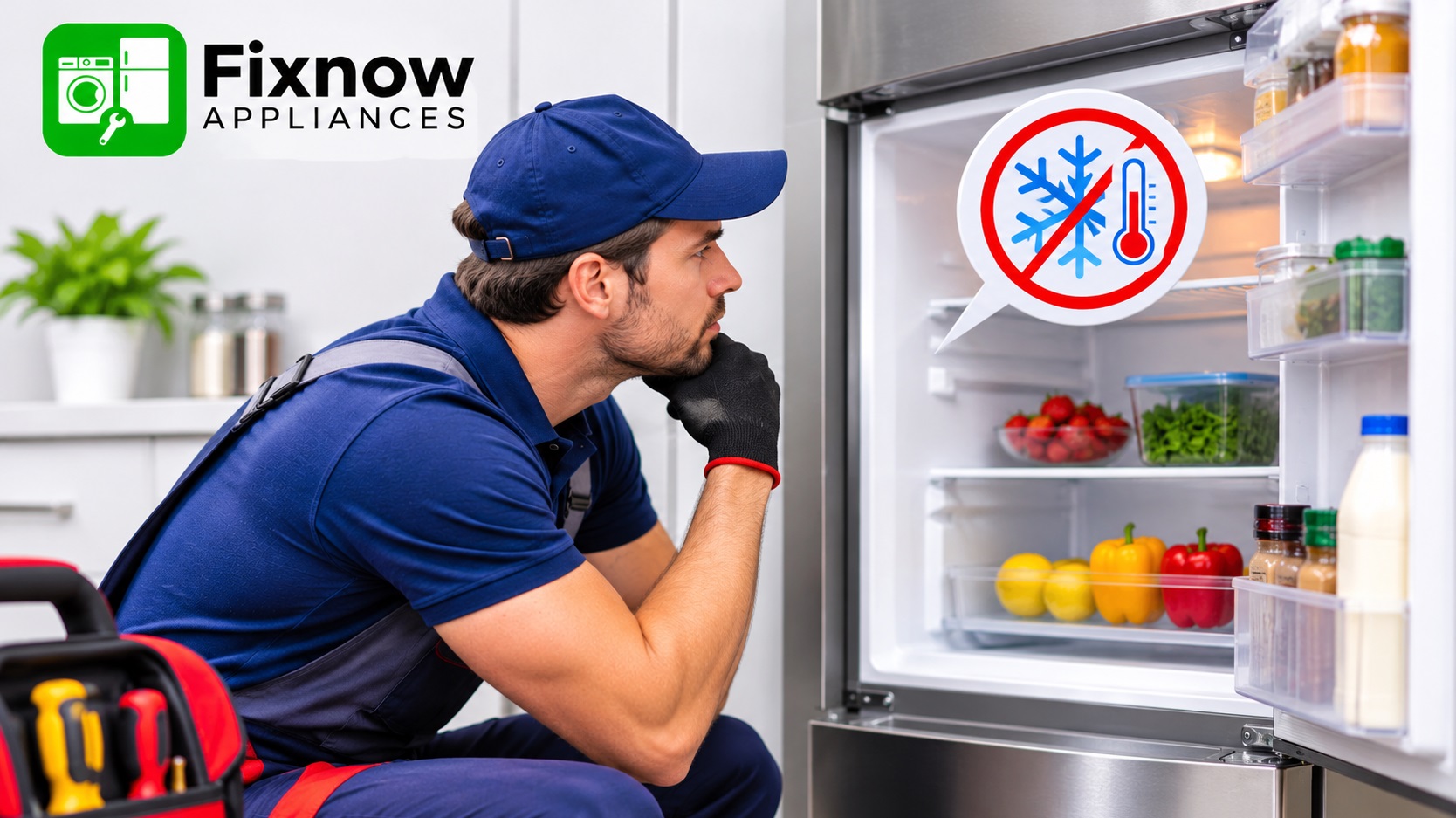
A refrigerator is one of the most important appliances in any home. It protects perishable food, keeps drinks cold and helps maintain everyday kitchen routines. When it stops cooling properly, even a small problem can quickly become stressful.
You may notice that milk feels warmer than usual, vegetables lose their freshness or the freezer continues working while the refrigerator compartment becomes warm. Sometimes, the appliance runs constantly without reaching the selected temperature.
The important thing to understand is that a refrigerator that is not cooling does not automatically need a new compressor or complete replacement. The problem may be related to airflow, dirty condenser coils, a faulty fan, temperature settings or another component.
This guide explains the common reasons a refrigerator stops cooling, safe checks homeowners can perform and when professional refrigerator repair may be necessary.
Before assuming that a refrigerator has developed a mechanical fault, check its temperature settings.
Someone may have accidentally changed the controls while cleaning, organising food or adjusting shelves.
A refrigerator set too warm may struggle to keep food properly chilled.
Confirm that the refrigerator is set to an appropriate cooling temperature.
Check whether the control panel displays an unusual setting.
Make sure the appliance is not in Demo, Vacation or Cooling Off mode, if applicable.
Consult the manufacturer's manual for recommended settings.
For many household refrigerators, approximately 3°C to 4°C (37°F to 40°F) is a suitable target for the fresh-food compartment. The freezer should generally be around -18°C (0°F).
Use an appliance thermometer to check the actual temperature rather than relying only on the display.
If the temperature remains too high after the settings are corrected, investigate other possible causes.
Condenser coils help release heat from the refrigerator's refrigeration system.
When dust, pet hair and debris accumulate around these coils, heat transfer can become less efficient. The refrigerator may have to work harder to maintain its internal temperature.
Refrigerator runs for unusually long periods.
Cooling performance gradually decreases.
Appliance feels warmer around certain external areas.
Energy consumption appears higher than usual.
Refrigerator struggles to maintain a stable temperature.
Check the manufacturer's manual for the location of the condenser coils.
Disconnect power before performing any permitted cleaning.
Remove accessible dust using the recommended cleaning method.
Make sure the refrigerator has adequate ventilation around it.
Restore power according to the manufacturer's instructions.
Some refrigerators have exposed coils, while others use different condenser arrangements. Do not remove panels or access internal electrical components unless you are qualified to do so.
If cleaning does not improve cooling, the appliance may need further diagnosis.
The evaporator fan moves cold air through the refrigerator and freezer compartments.
If the fan stops working properly, cold air may not circulate as designed.
This can create a situation where one compartment feels colder than the other.
Refrigerator compartment is warm.
Freezer appears colder than the refrigerator.
Airflow from internal vents is weak or absent.
Unusual humming, rattling or grinding sounds occur.
Cooling performance becomes inconsistent.
Faulty evaporator fan motor.
Ice buildup around the fan.
Damaged fan blades.
Electrical connection problems.
Control-system malfunction.
Listen for unusual noises during normal operation.
Check whether food packages are blocking internal vents.
Look for visible frost buildup around accessible areas.
Avoid removing internal panels to reach the fan.
If the fan appears to be malfunctioning, professional inspection can determine whether the motor, wiring or defrost system needs attention.
Refrigerators depend on proper airflow to distribute cold air throughout their compartments.
When food containers, bags or large packages block the air vents, certain areas may become warmer than others.
Some shelves feel colder than others.
Food near the vents becomes partially frozen.
Items stored farther from the vents feel warmer.
Cooling performance changes after loading groceries.
Avoid placing food directly against air vents.
Leave space between containers.
Do not overcrowd the refrigerator.
Arrange food so air can circulate around the shelves.
Check the manufacturer's recommended storage arrangement.
Good organisation can improve airflow and help the refrigerator maintain more consistent temperatures.
If cooling remains uneven after rearranging food, another component may be responsible.
The door gasket creates a seal between the refrigerator door and its cabinet.
If the seal becomes loose, cracked or damaged, warm air can enter the refrigerator while cold air escapes.
This can make the compressor work harder and affect cooling performance.
Door does not close properly.
Visible cracks or gaps around the gasket.
Moisture or condensation near the door.
Refrigerator runs more frequently than usual.
Food does not stay cold consistently.
Inspect the visible gasket for damage, dirt or areas that do not sit properly against the cabinet.
Clean it according to the manufacturer's instructions and check whether the door closes securely.
If the gasket is torn, loose or no longer seals properly, it may need replacement.
A refrigerator uses temperature-control components to monitor internal conditions and regulate cooling.
Depending on the model, this may involve a thermostat, thermistor or electronic temperature-control system.
If these components provide inaccurate readings, the refrigerator may not cool as expected.
Refrigerator temperature fluctuates.
Cooling starts and stops unexpectedly.
Food becomes warmer than normal.
Refrigerator runs continuously.
Temperature settings do not appear to make a difference.
Defective temperature sensor.
Faulty thermostat.
Damaged wiring.
Control-board malfunction.
Incorrect sensor readings.
These components may be located inside areas that require appliance disassembly.
A professional technician can test the temperature-control system and identify the component responsible.
Most modern frost-free refrigerators use an automatic defrost system to prevent excessive ice from accumulating around the evaporator.
If the defrost system fails, frost may gradually build up and restrict airflow.
The refrigerator may initially appear to work normally before cooling performance begins to decline.
Thick frost or ice inside the freezer.
Refrigerator compartment becoming warm.
Weak airflow from internal vents.
Fan noise caused by ice interference.
Cooling problems that gradually become worse.
Faulty defrost heater.
Defective defrost thermostat or sensor.
Defrost control malfunction.
Blocked or frozen drainage system.
Control-board problems.
Check for visible frost buildup without removing internal panels.
Do not use knives, screwdrivers, heat guns or sharp objects to remove ice. These can damage internal components or refrigeration lines.
If the appliance has a recurring frost problem, professional diagnosis is recommended. Simply removing visible ice may not address the underlying defrost fault.
The condenser fan helps move air across the condenser area in refrigerator models that use one.
If the fan stops operating, the refrigerator may struggle to release heat efficiently.
Refrigerator becomes unusually warm.
Cooling performance decreases.
Compressor runs for extended periods.
Unusual noises come from the lower or rear area.
Appliance overheats around the condenser section.
Faulty condenser fan motor.
Damaged fan blade.
Dust or debris restricting movement.
Electrical connection problem.
Control-system fault.
The fan may be located behind an access panel. Avoid attempting to reach it while the appliance is connected to power.
A technician can inspect the fan motor and related components safely.
The compressor is a central part of the refrigeration system. It helps circulate refrigerant through the cooling cycle.
If the compressor fails or cannot operate correctly, the refrigerator may lose its ability to maintain cold temperatures.
Refrigerator and freezer are both warm.
Compressor does not appear to start.
Clicking sounds occur repeatedly.
Appliance runs without achieving proper cooling.
Cooling performance deteriorates significantly.
However, these symptoms do not automatically confirm compressor failure. Electrical components, start devices, control boards and refrigeration-system faults can produce similar behaviour.
Compressor diagnosis requires appropriate testing and equipment.
Do not attempt to open or repair the sealed refrigeration system yourself. Refrigerant handling and sealed-system work should be performed by appropriately qualified professionals in accordance with applicable regulations.
One common complaint is a refrigerator compartment that feels warm while the freezer continues to keep food frozen.
This often suggests a problem with cold-air distribution rather than a complete failure of the refrigeration system.
Blocked air vents.
Faulty evaporator fan.
Excessive frost buildup.
Defrost-system malfunction.
Air damper problem.
Incorrect loading or storage arrangement.
Make sure food is not blocking the vents.
Check for unusual frost buildup.
Confirm that the refrigerator door closes properly.
Verify the temperature settings.
Monitor the actual refrigerator temperature with a thermometer.
If the freezer remains cold but the fresh-food section does not, professional diagnosis can help identify the airflow or defrost component involved.
A power interruption can sometimes affect refrigerator operation.
After electricity returns, the appliance may need time to resume normal cooling. Some models may also display an error code or require their settings to be checked.
Power supply interruption.
Tripped circuit breaker.
Incorrect control settings.
Electronic control fault.
Compressor start-related problem.
Confirm that the refrigerator has power.
Check the display for error messages.
Verify that cooling has not been disabled.
Check the electrical panel if safe to access.
Follow the manufacturer's restart instructions.
If the appliance repeatedly trips the breaker, makes unusual electrical noises or fails to cool after the power supply is restored, stop troubleshooting and arrange professional inspection.
A refrigerator does not always return to its target temperature immediately after being switched on, moved or affected by a power interruption.
The recovery time depends on the appliance model, ambient temperature, food load and how warm the compartments became.
A newly installed refrigerator may require several hours to reach its recommended operating temperature. Some manufacturers recommend allowing up to 24 hours for full temperature stabilisation.
Always follow the instructions for your specific model.
However, do not wait if the appliance is showing signs of an electrical fault, burning smell, unusual overheating or another safety concern.
A refrigerator that is not cooling properly can create food-safety concerns.
Perishable food should generally be kept at or below 4°C (40°F).
According to common food-safety guidance, perishable food that has remained above 4°C for more than two hours may need to be discarded. The time limit is shorter in very hot conditions.
Keep refrigerator and freezer doors closed as much as possible.
Check the temperature with an appliance thermometer.
Move vulnerable food to a properly working refrigerator or cooler with ice if necessary.
Avoid tasting food to determine whether it is safe.
Follow local food-safety guidance when deciding what to discard.
If the refrigerator has stopped cooling, protecting food should be the priority while arranging diagnosis and repair.
Some problems can be addressed through basic checks, such as adjusting the temperature setting, cleaning an accessible lint-free condenser area where permitted or rearranging food to improve airflow.
However, internal mechanical, electrical and refrigeration-system faults require appropriate training.
Consider arranging professional refrigerator repair if:
Refrigerator temperature remains too high.
Freezer works but the refrigerator compartment stays warm.
Compressor repeatedly clicks or struggles to start.
Internal fans make unusual noises.
Thick frost repeatedly develops.
Refrigerator runs constantly without cooling properly.
Temperature controls do not respond.
Water leakage appears alongside cooling problems.
Error codes keep returning.
Stop using the appliance and seek appropriate assistance if you notice smoke, sparks, burning electrical smells or signs of an electrical fault.
Preparing a few details before contacting a repair company can make the service process more efficient.
Determine whether your appliance is:
Single-door refrigerator.
Double-door refrigerator.
Top-freezer refrigerator.
Bottom-freezer refrigerator.
Side-by-side refrigerator.
French-door refrigerator.
Built-in refrigerator.
Mini refrigerator.
Different designs use different airflow, defrost and cooling arrangements.
The model number helps identify the appliance specifications and compatible replacement parts.
It is often located inside the refrigerator compartment, around the door frame or on a manufacturer label.
Explain exactly what happens.
For example:
Refrigerator runs but does not cool.
Freezer works but fridge section is warm.
Both compartments are warm.
Refrigerator makes clicking sounds.
Excessive frost develops.
Cooling works intermittently.
Display shows an error code.
Before confirming a service appointment, ask:
Is my refrigerator brand and model supported?
Is a diagnostic or service-call fee applicable?
Will I receive an estimate before repairs begin?
Are compatible replacement parts available?
What warranty applies to completed repairs?
What is the expected service process?
These questions help establish clear expectations before the technician visits.
A refrigerator that stops cooling does not automatically need replacement.
Many cooling problems can be resolved by repairing an individual component. However, the best decision depends on the appliance's age, condition and repair requirements.
Consider:
Age of the refrigerator.
Frequency of previous breakdowns.
Availability of compatible parts.
Extent of the cooling-system problem.
Repair estimate.
Energy efficiency.
Expected reliability after repair.
A relatively new refrigerator with a faulty fan, sensor or door gasket may be a suitable repair candidate.
An older appliance with recurring failures or an expensive sealed-system problem may require a replacement assessment.
A professional diagnosis helps homeowners compare repair and replacement options before making a decision.
Regular maintenance can help support cooling performance and identify developing issues early.
Avoid overcrowding shelves and blocking air vents. Proper airflow helps distribute cold air throughout the compartment.
Follow the manufacturer's instructions for cleaning accessible condenser areas and removing dust.
Check the gasket periodically for cracks, dirt or gaps that may allow warm air to enter.
Opening the refrigerator repeatedly allows warm air to enter and can affect internal temperature.
Allow hot food to cool appropriately before refrigeration, and avoid overloading the appliance with large quantities of warm items.
Use an appliance thermometer to confirm that the refrigerator and freezer are maintaining suitable temperatures.
New clicking, grinding or buzzing noises may indicate a developing mechanical problem.
Maintenance cannot prevent every breakdown, but it can help reduce avoidable cooling problems.
When a refrigerator stops cooling, accurate diagnosis is essential. Replacing components without identifying the underlying fault can lead to unnecessary expense and recurring problems.
FixNow Appliances provides appliance repair services for household refrigerators and other major appliances.
Whether your refrigerator is not cooling, the freezer works while the fresh-food section stays warm, or the appliance makes unusual noises, identifying the symptoms and model number is a useful first step.
Before booking, discuss your refrigerator's condition, service location, diagnostic charges, repair estimate and applicable warranty terms with the company.
Company: FixNow Appliances
Website: https://fixnowappliances.ca/
Contact FixNow Appliances to discuss your refrigerator cooling problem and confirm service availability for your location.
A refrigerator may run without cooling properly because of dirty condenser coils, a faulty evaporator fan, blocked air vents, a damaged door gasket, temperature-control problems or compressor-related issues.
This can happen when cold air is not circulating properly between compartments. Possible causes include a blocked air vent, faulty evaporator fan, defrost-system problem or malfunctioning air damper.
Yes. Dust and debris around condenser coils can reduce heat transfer and make cooling less efficient. Cleaning accessible areas according to manufacturer instructions may help.
Possible warning signs include poor cooling in both compartments, repeated clicking, unusual operating sounds and extended running without reaching the correct temperature. These symptoms require professional diagnosis because other faults can cause similar behaviour.
Clicking may come from normal operating cycles, but repeated clicking combined with poor cooling may indicate a compressor start component, electrical or control-system problem.
A common recommendation is approximately 3°C to 4°C (37°F to 40°F) for the fresh-food compartment and -18°C (0°F) for the freezer. Check the manufacturer's recommendations for your specific model.
Cooling time varies by model and operating conditions. A newly installed refrigerator may take several hours to cool, and some manufacturers recommend allowing up to 24 hours for temperature stabilisation.
Food safety depends on how warm the food became and how long it remained at that temperature. Perishable food held above 4°C (40°F) for more than two hours may be unsafe. Follow recognised food-safety guidance and do not taste food to test its safety.
You can safely check temperature settings, door closure, food placement and accessible airflow areas. Internal electrical components, fans, compressors and sealed refrigeration systems should be assessed by appropriately qualified professionals.
Arrange professional inspection if the refrigerator remains warm, the freezer and refrigerator temperatures differ significantly, unusual noises occur, frost repeatedly builds up or the appliance fails to respond to basic checks.
Visit https://fixnowappliances.ca/ to contact FixNow Appliances, explain the cooling issue and confirm service availability for your location.


Leave A Reply
Your email address will not be published. Required fields are marked *